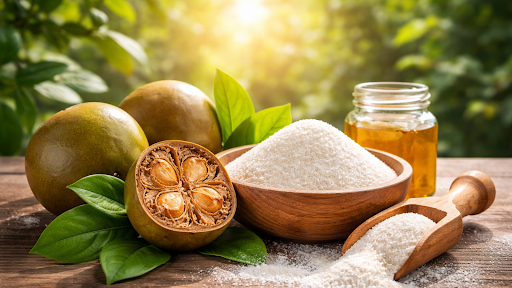
Monk fruit is one of the sweeteners often marketed as safer and more effective than traditional sugar. However, health-conscious individuals often question whether a sweetener or any other ingredient can be a part of their diet. This article aims to clear any doubts about monk fruit sweetener and to suggest alternatives if you have certain sensitivities. At the end of the article, you will have the knowledge to decide whether you should buy monk fruit sweetener or consider some other conventional sugar substitute.
Origin and History
Monk fruit, or Luo Han Guo, is native to the forested mountains of Guilin in the Guangxi province of southern China. It requires a very specific environment, including high altitude, significant shade, high humidity, and a constant mist that protects the vines from direct, intense sunlight.
It remained a regional secret for centuries, cultivated on small, terraced mountain plots. Legend suggests that the fruit was first identified and cultivated in the 13th century (during the Yuan Dynasty) by Buddhist monks.
Traditional Chinese medicine classified it as a cooling herb used to balance “internal heat.”
The fruit was used to treat:
- Respiratory stress, such as sore throats, acute bronchitis, and chronic coughs.
- Digestive issues, such as constipation
With modern aqueous extraction perfected in the early 2000s, this breakthrough transformed a 13th-century medicinal gourd into the premier natural sweetener of the 21st century.
The Manufacturing Process
Ripe green monk fruit is harvested and fermented, and it turns rancid within days of being picked. The fruit’s pulp is crushed to release the juice, which is then infused with hot, purified water.
Water, acting as a solvent, draws the mogrosides (the sweet compounds) while leaving behind most of the fruit’s sugars and proteins.
The resulting liquid is a dark, tea-like infusion that undergoes a series of filtration steps to achieve a “clean” taste and white appearance. The juice is passed through a special resin that “catches” the mogrosides, allowing the fructose and glucose to pass through and be discarded.
The liquid is concentrated, spray-dried, and atomized into a hot-air chamber, where the water evaporates instantaneously, leaving behind a fine, highly concentrated powder. The final extract is roughly 250 times as sweet as sucrose. This is why it is frequently blended with “bulking agents” such as erythritol to achieve a 1:1 ratio with sugar.
Biochemistry of Mogrosides
Monk fruit contains a class of compounds called mogrosides, responsible for its intense, non-caloric sweetness. There are different types of mogrosides (labeled I through VI), with Mogroside V being the most dominant, providing roughly 250–300 times the sweetness of traditional sugar.
How Does the Body Process Monk Fruit?
Mogrosides pass through the upper digestive tract intact, without entering the bloodstream and causing a rise in blood glucose or insulin levels. Your gut microbiota breaks down the mogrosides, consuming the glucose units attached to the backbone of the molecule. However, because this process occurs so late in the digestive chain and involves gut flora rather than metabolic enzymes, the resulting components are largely excreted.
Mogrosides are classified as antioxidants that help inhibit reactive oxygen species (ROS) and neutralize free radicals, protecting DNA from damage and reducing oxidative stress within cells.
Health Benefits
Most people turn to monk fruit for the following benefits:
- Zero glycemic index (GI), which means no blood glucose spikes and insulin neutrality
- Weight management and obesity prevention
- Neutralization of free radicals, preventing DNA damage and cellular aging
- Good for individuals with dental issues
Reading the Label
When you buy monk fruit sweetener at the market, it is most likely not in its pure form. It contains fillers to standardize the sweetness and provide the bulk necessary for cooking and baking. The health benefits of monk fruit sweetener in your kitchen depend on the filler.
| Filler | Harmful Effects |
| Erythritol |
|
| Maltodextrin/Dextrose |
|
| Inulin and Soluble Fibers |
|
Taste Profile and Culinary Science
| Feature | Performance |
| Sweetness | Intense (250x traditional sugar) |
| Aftertaste | Clean and fruity |
| Heat Stability | Stable up to 200°C |
| Browning | Zero |
| Texture | No “Bulk” |
| Moisture | Low |
Risks and Side Effects
Depending on the filler and individual sensitivities, monk fruit may have the following side effects:
- Can raise blood sugar levels in diabetics
- May affect fertility
- May cause autoimmune problems
- May cause faulty insulin regulation
Commercially available monk fruit is not only expensive but may also be genetically modified.
Monk Fruit Alternative
Allulose has emerged as the safest alternative not only to traditional sugar but also to monk fruit and other sweeteners. While it is also zero-calorie and zero GI, it is 70% as sweet as conventional sugar. So, the allulose sweetener in your kitchen contains no fillers.
Jaca Rare Sugar
| Jaca | Monk Fruit | |
| Tastes like sugar | ✔ | ✔ |
| Zero calories | ✔ | ✔ |
| Zero glycemic index | ✔ | ✔ |
| Melts, browns, and caramelizes | ✔ | ✗ |
| Cooking & baking | ✔ | ✔ |
| Suitable for beverages | ✔ | ✔ |
| FODMAP friendly | ✔ | ✔ |
| Keto friendly | ✔ | ✔ |
| No hunger or sugar cravings | ✔ | ✗ |
Jaca rare sugar provides the benefits of allulose, supporting a healthier lifestyle without sacrificing sweetness. It is backed by 30 years of clinical data and is also perfect for cooking and baking, making it the healthiest sugar alternative for everyday use.
Now you can become an advocate of a healthier lifestyle by joining the Jaca Affiliate Program.
Don’t forget to follow us for the latest updates.
Got any questions? AskSweetie, sweetener expert, got answers!