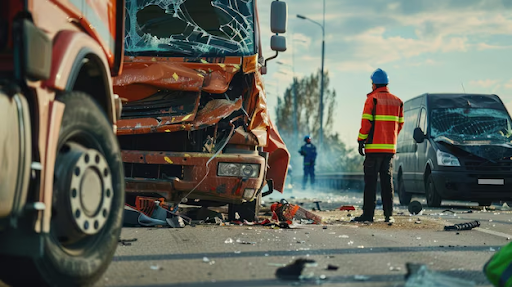
When a truck crash happens, people often assume responsibility rests with a single driver. In practice, trucking is a system: drivers operate vehicles maintained by someone, dispatched by someone, and loaded by someone.
That’s why truck accident liability can involve more than one party, and why investigations look beyond the moment of impact to the decisions and conditions that led up to it.
Why liability is more complex in trucking than in typical crashes
Multiple operational layers
Commercial transport involves policies, training, maintenance schedules, and delivery deadlines. Those layers can influence behavior and vehicle condition.
More than one insurance relationship
Different entities can carry different coverage, which can affect how responsibility is evaluated and negotiated.
Common potentially responsible parties in truck crashes
The truck driver
Driver responsibility may involve speed, distraction, impairment, unsafe lane changes, or failure to adapt to conditions.
The trucking company or motor carrier
Carriers may be responsible for hiring practices, training quality, scheduling pressures, and maintenance compliance.
Examples of carrier-level issues
- Inadequate training for route or weather
- Unrealistic delivery windows
- Poor safety enforcement
- Maintenance shortcuts or deferred repairs
Maintenance and repair providers
If a third party handled inspections or repairs, their work quality may be relevant—especially in brake, tire, or steering failures.
Shippers and cargo loaders
Improper loading can cause:
- Load shift and instability
- Overweight conditions
- Securement failures
Vehicle or parts manufacturers
Defective components (tires, brakes, coupling systems) can contribute to loss of control or failure to stop.
How “shared fault” can apply
Liability can be distributed among multiple parties depending on each party’s conduct and causal role. That means:
- One party may be primarily responsible
- Others may share smaller percentages
- Evidence determines how responsibility is allocated
What usually drives fault allocation
- Traffic dynamics (who moved where, when)
- Vehicle condition and maintenance records
- Speed and braking evidence
- Witness accounts and scene documentation
The role of evidence in determining liability
Scene and crash-dynamics evidence
Photos, skid marks, debris patterns, and vehicle damage can clarify angles and timing.
Operational records
Logs, inspection history, and dispatch patterns can explain whether fatigue or mechanical issues were predictable.
Practical note: liability is a story backed by records
A good truck accident lawsuit guide mindset is to treat liability as a structured narrative: what happened, why it happened, and who had control over the risk factors.
Misconceptions that lead to confusion
“If the truck hit me, the truck is automatically at fault”
Rear-end crashes often suggest fault, but investigations still examine sudden lane changes, brake lights, road hazards, and traffic waves.
“Only what happened at the scene matters”
Pre-crash decisions—maintenance, loading, scheduling—can be central to explaining why the crash occurred.
“One signature document will prove everything”
Truck cases are usually resolved through the weight of multiple consistent records rather than a single decisive piece of proof.
What Drivers Can Do Immediately After a Crash to Preserve Liability Clarity
- Photograph Wide Scene Context, Not Just Damage
Capture signage, lane markings, and work-zone conditions. These images provide context and help show how the accident unfolded. - Collect Witness Contacts Quickly
Witnesses may forget crucial details over time. Get names and numbers before they leave the scene. - Seek Prompt Medical Evaluation to Document Injury Onset
Even if you feel fine initially, seeing a doctor early on will help document the timeline of injuries. - Keep a Simple Timeline of Symptoms, Visits, and Expenses
Track your recovery process, appointments, and any ongoing limitations for future reference in your case.
Additional Point: The Role of the Dispatcher in Liability
In some cases, the dispatcher’s role can contribute to the accident. Pressure to meet deadlines or unrealistic route instructions can lead a driver to take risks they otherwise wouldn’t. If a dispatcher was involved in creating the conditions that led to an accident (such as not accounting for traffic patterns or scheduling sufficient rest), they could share some liability.
Additional Point: Weather and Environmental Factors
While weather conditions may not be directly caused by the parties involved, they can heavily influence the outcome of truck accidents. In conditions like rain, fog, or icy roads, liability may be shared if a driver or company failed to take appropriate measures (e.g., reducing speed or ensuring proper tire maintenance). Documenting environmental conditions during the accident and how they impacted vehicle control can strengthen a case by showing how weather played a role.
Konklusion
Truck accident liability is often multi-layered because trucking is multi-layered. Responsibility may involve drivers, carriers, maintenance providers, loaders, or manufacturers depending on the evidence. The clearest outcomes usually come from early documentation, consistent medical records, and a thorough look at how operational decisions shaped the moments leading up to the crash.