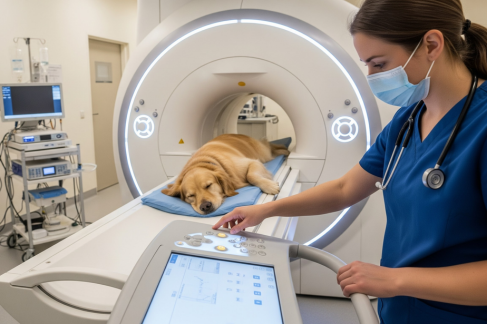
Magnetic Resonance Imaging (MRI) has become one of the most valuable diagnostic tools in veterinary medicine—especially when it comes to identifying neurological disorders in dogs. As neurological conditions often show symptoms similar to orthopedic or metabolic issues, pinpointing the exact cause can be challenging.
Veterinary MRI offers a clear and highly detailed look inside a dog’s brain, spinal cord, and surrounding structures, helping veterinarians reach accurate diagnoses and create effective treatment plans.
Understanding the Importance of MRI in Veterinary Neurology
Neurological disorders in dogs can range from mild to life-threatening. Common symptoms include seizures, head tilting, loss of balance, paralysis, sudden blindness, neck or back pain, and unexplained behavioral changes. Traditional imaging methods, such as X-rays and CT scans, may not always detect subtle abnormalities in soft tissues like nerves and brain matter. MRI, however, produces superior contrast and precision, allowing clinicians to detect even minute lesions and abnormalities.
This imaging technique is non-invasive and uses magnetic fields instead of ionizing radiation, making it safe for repeated evaluations. For dogs with chronic or progressive neurological signs, MRI often becomes the gold standard for accurate diagnosis.
How Veterinary MRI Works
MRI technology uses powerful magnets and radio waves to generate detailed images of internal structures. When a dog undergoes an MRI, it is placed inside a magnetic field, where radiofrequency pulses help create cross-sectional images of tissues. These images are then converted into high-resolution 3D visuals.
Dogs are placed under general anesthesia for the scan to ensure complete stillness, as the procedure is sensitive to even the slightest movement. Although anesthesia carries minimal risks, modern veterinary hospitals use advanced monitoring systems to ensure safety throughout the procedure.
Conditions That MRI Helps Detect in Dogs
MRI plays a critical role in uncovering a wide range of neurological conditions that might otherwise go undetected. Some of the most common include:
Intervertebral Disc Disease (IVDD)
IVDD is a spinal condition seen frequently in breeds like Dachshunds, Beagles, Cocker Spaniels, and French Bulldogs. MRI provides the most accurate visualization of disc herniation, spinal cord compression, and the exact location of the issue. This helps veterinarians determine whether a dog needs medical management or surgical intervention.
Brain Tumors
MRI is the preferred diagnostic tool for identifying brain tumors because it clearly distinguishes between normal and abnormal tissue. It can detect the size, shape, location, and potential spread of tumors, aiding in treatment planning—which may include surgery, radiation, or palliative care.
Epilepsy and Seizure Disorders
Seizures in dogs can be caused by structural abnormalities in the brain. This advanced imaging for pets helps rule out conditions like tumors, infections, inflammation, or congenital defects before diagnosing idiopathic epilepsy. Detecting structural causes early allows timely treatment.
Inflammatory Brain Diseases (Meningitis, Encephalitis)
Dogs may develop inflammation of the brain or spinal cord due to infections, autoimmune disorders, or unknown causes. MRI can reveal signs of swelling, lesions, and fluid accumulation, helping veterinarians differentiate between types of inflammatory diseases.
Stroke (Cerebrovascular Accidents)
Although less common in dogs than in humans, strokes can occur. MRI is the most sensitive imaging method for detecting ischemic or hemorrhagic strokes. Early detection allows for more effective management and rehabilitation.
Congenital Brain Abnormalities
Some dogs are born with structural abnormalities like hydrocephalus, Chiari-like malformations, or malformations of the skull and brain. MRI helps visualize these defects clearly, enabling veterinarians to understand the severity and recommend appropriate treatment.
Advantages of Veterinary MRI Over Other Imaging Modalities
MRI offers several significant benefits when evaluating neurological disorders in dogs:
Superior Soft Tissue Detail
MRI provides unmatched detail of soft tissues, making it ideal for diagnosing brain and spinal cord issues.
No Radiation Exposure
Unlike CT scans or X-rays, MRI does not use ionizing radiation, making it safer for repeated evaluations.
Early Detection of Subtle Abnormalities
MRI can detect tiny lesions or abnormalities that may be impossible to see using other methods, supporting earlier diagnosis and better outcomes.
Multi-Planar Imaging
Veterinarians can view structures from various angles (sagittal, coronal, transverse), allowing for a more complete understanding of the problem.
Essential for Pre-Surgical Planning
When surgery is needed, MRI provides a detailed roadmap, reducing risks and improving surgical outcomes.
Preparing a Dog for MRI
Before the scan, the veterinarian performs a physical examination, neurological evaluation, and bloodwork to ensure the dog can safely undergo anesthesia. Food is usually restricted for several hours before the procedure. During the MRI, an anesthesiologist or veterinary technician monitors vital signs such as heart rate, oxygen levels, and blood pressure. After the scan, dogs typically recover from anesthesia within a few hours.
How MRI Results Influence Treatment Plans
Accurate MRI results allow veterinarians to create individualized treatment plans that may include:
- Medication: Anti-inflammatory drugs, pain relievers, antibiotics, or anti-seizure medications.
- Surgery: For conditions like IVDD, tumors, or congenital defects.
- Physical Therapy: Rehabilitation and physiotherapy, especially after spinal injuries.
- Long-Term Monitoring: Follow-up MRIs for chronic conditions or recovery assessments.
A precise diagnosis ultimately improves prognosis and quality of life.
The Bottom Line
Veterinary MRI is a vital tool in detecting and diagnosing neurological disorders in dogs. Its ability to capture highly detailed images of the brain, spinal cord, and surrounding tissues makes it indispensable in modern veterinary neurology. Whether identifying a herniated disc, diagnosing a brain tumor, or evaluating seizures, MRI helps veterinarians make informed decisions that lead to better, faster, and more effective treatments.
If you are looking for the best clinic for veterinary MRI, you can rely on Veterinary Neurology Of The Chesapeake. For more information, visit the site.