The modern working environment has a specific physical cost that rarely shows up on an itemised invoice. Prolonged sitting — particularly in the forward-flexed, head-forward posture that desk work produces — places chronic mechanical load on the spine and surrounding structures in ways that accumulate silently over months and years before producing the pain or limitation that finally brings someone into a clinic.
Understanding the mechanism helps explain why the problem is so common, and why interventions that address only the symptom without the underlying pattern tend to produce limited, temporary results.
What Sitting Does to the Spine
The lumbar spine has a natural inward curve — the lumbar lordosis — that is maintained by the muscles and ligaments surrounding it. In a neutral standing posture, this curve distributes compressive forces evenly across the disc and facet joint surfaces of each lumbar segment.
In a typical seated posture, particularly one that allows the pelvis to posteriorly tilt (rolling back), the lumbar lordosis flattens. The disc spaces adopt a wedge shape that concentrates load on the front of the disc and stretches the posterior ligaments and facet joint capsules. Held for an hour or two, this is unremarkable. Held for six to eight hours daily, across years of a working career, it produces structural changes: disc dehydration, progressive posterior disc loading, and the gradual loss of the lumbar curve that makes standing briefly uncomfortable for people who have spent decades sitting.
The cervical spine faces a parallel problem. The head weighs approximately ten to twelve pounds in a neutral position, balanced over the cervical spine. For every inch the head moves forward of the shoulders, the effective load on the cervical spine approximately doubles. An average desk worker with moderate forward head posture may be loading their cervical spine with the equivalent of forty to fifty pounds of compressive force — sustained, hour after hour, across the workday.
The Muscle Consequences
The postural pattern that desk work drives produces predictable muscular imbalances. Some muscles — the hip flexors, upper trapezius, pectoral muscles, and cervical extensors — become shortened and chronically hypertonic. Others — the deep cervical flexors, lower trapezius, gluteal muscles, and mid-thoracic stabilisers — become inhibited and relatively weakened.
These imbalances create a self-reinforcing loop. Short hip flexors pull the pelvis into anterior tilt, which increases lumbar compression. Weakened deep cervical flexors allow the head to drift forward, increasing cervical load. The posture that produces these imbalances is also the posture that the imbalances make more comfortable — because the muscles that should counteract the poor position are too weak to sustain the effort.
Stretching alone rarely resolves this pattern. The shortened muscles need to be lengthened, but the inhibited muscles also need to be strengthened — and the joint restrictions that typically accompany this pattern need to be addressed separately.
The Kirkland Clinical Context
Among the population who regularly seek care from kirkland chiropractors, desk workers with desk-driven postural dysfunction are a significant and consistent group. Their presentations tend to cluster around the same areas: lower cervical and upper thoracic restriction, upper trapezius and levator scapulae tension, lumbar facet restriction, and hip flexor shortness.
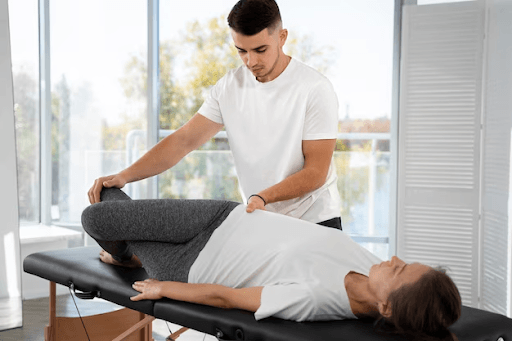
The most effective approach to this pattern — and what the practitioners at Prime Spines deliver — combines joint mobilisation or manipulation of the restricted segments with therapeutic soft tissue work on the shortened muscles, followed by targeted rehabilitative exercises to address the inhibited muscles that are failing to counteract the postural load.
Ergonomics: Necessary but Not Sufficient
Ergonomic adjustments — monitor height, chair support, keyboard positioning, sitting-to-standing desk ratios — are genuinely useful interventions. They reduce the rate at which postural load accumulates and can prevent new dysfunction from developing. But they do not reverse existing structural changes, they do not release shortened fascial tissue, and they do not retrain inhibited muscles.
The person who corrects their ergonomic setup after years of problematic posture will slow the accumulation of further damage — but without addressing the tissue and joint changes that have already occurred, they will remain symptomatic. Both the environmental modification and the clinical treatment are necessary parts of the solution.
Building Habits That Counteract Desk Load
Beyond clinic-based care, a few consistently applied habits reduce the postural burden of desk work significantly:
Movement breaks every 45 to 60 minutes — standing, walking briefly, or doing a simple mobility exercise — interrupt the continuous postural loading that desk work imposes. Even 90 seconds of movement has a meaningful physiological effect on the tissue.
Thoracic extension over a chair back or foam roller counteracts the flexion that sitting produces, maintaining thoracic mobility and reducing the forward pull on the cervical spine.
Hip flexor stretching — a sustained, patient stretch rather than a brief hold — addresses one of the most consistently shortened muscle groups in desk workers.
Conclusion
The physical cost of prolonged desk work is real, specific, and cumulative — but it is also addressable through the right combination of clinical care and consistent daily habits. For Kirkland residents experiencing the back pain, neck tension, or headaches that this pattern produces, understanding the mechanism is the first step toward choosing interventions that address the problem at its source rather than managing its symptoms indefinitely.
For More Info Visit:- flowactivo.org